By Char Stratton, Argus Correspondent
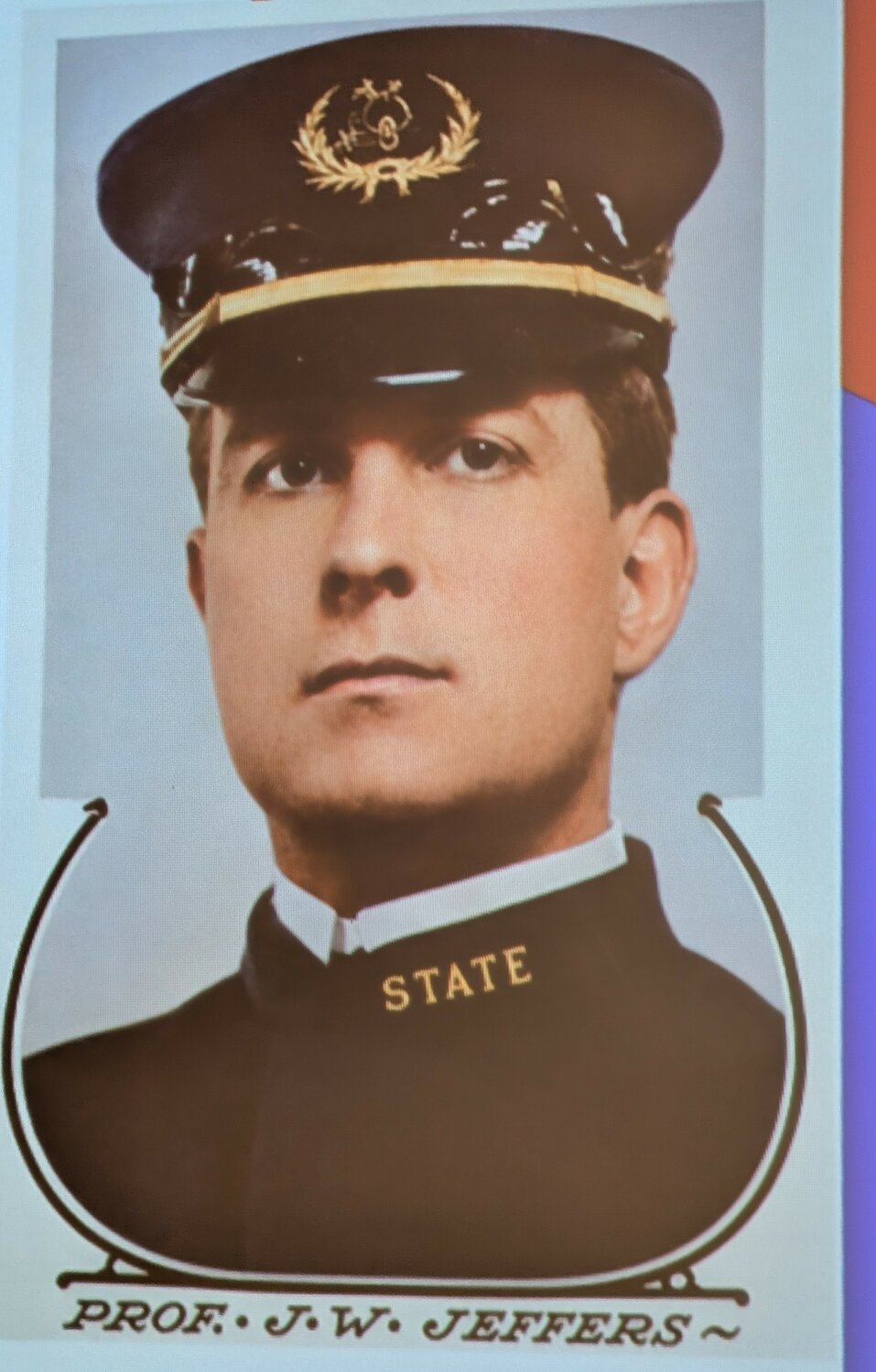
In a special program presented by Pete Dusterbeck and the Wild Rose Historical Society on May 2, the community recently gathered to honor the life of a local legend who truly lived up to the title: “The Music Man.” James Ward Jeffers (1867–1970) was a man whose life spanned over a century of American melody. Born in Wild Rose as the fifth of ten children, his journey didn’t begin with a baton; in the year 1900, he was listed as a painter working with his family. But in those years, music was the heart of all entertainment, and Ward Jeffers embraced it with everything he had. He didn’t just learn to play; he mastered the piano, cornet, and harmonica, eventually learning many instruments that would define his long career.
A Conductor’s Journey
Jeffers’ talent soon took him far beyond the borders of Wild Rose. He traveled the Midwest, playing with the Putnam Band in Fargo, South Dakota, and the Danz Concert Band in Como Park, Minneapolis. By 1910, he made a major announcement: he would serve with the Iowa State Band.
From 1910 to 1915, he served as the conductor and director of the Iowa State Band and operated the Jeffers Chautauqua and Lyceum Bureau. His life was a whirlwind of musical activity:
•1911: Performed with the Des Moines Iowa State Band.
•1913: Owned the Princess Theater in Mason City, Iowa (which later burned down in 1933).
•1916: Served as a piano tuner in Emmetsburg and a musical instructor in Britt, Iowa.
•Leadership: He was placed in charge of the Mason City Band and Symphony Orchestra.
Building Bands and Changing Lives
Ward Jeffers was known for establishing many bands in many places. He had a gift for teaching both adults and children how to play instruments. Under his leadership, these students were provided with uniforms, and the bands grew, providing years of entertainment and musical education to their communities.
His influence stretched across the map, including Wauchula and Tampa, Florida, Sycamore and DeKalb, IL, Clarion High School in Iowa, and even Paris, France (where he led an American Legion Band at a convention).
In 1935, his work took on a philanthropic note. He signed a contract with the Egypt Temple Shrine to organize a junior drum and bugle corps during the summer months, and that same year, he worked in a school for orphaned children, sharing the gift of music with those who needed it most.
The Final Movement
While his musical life was a triumph, his personal life saw brief chapters. He was married and soon divorced early on, and later had a short marriage of about two years to Imogen Morning Star before they also divorced.
However, his relationship with the public never wavered. In 1958, the Des Moines Register published a major article about “The Music Man and His Boys Bands.” At the age of 80, Jeffers sat down to tell the story of his life as a Music Man—a story that began in the small village of Wild Rose and echoed across the world for 103 years.
“He taught them how to play... they got uniforms and the bands grew. They played for so many, providing years of entertainment and learning.”



Comments
No comments on this item Please log in to comment by clicking here