By Karen Kurth, Argus Correspondent
As I parked in a convenient spot in front of the Wild Rose Historical Society Museum, I noticed three observers on the front porch. Cringe. I couldn’t hide because I was the roaming correspondent meeting Helen Cox for this interview.
Three avid volunteers greeted me: Sharon Merryfield, Mike Wilson, and Bill Roop. I quickly learned that this wasn’t the average local museum scraped together with photos of the town’s founding fathers. No, this is a treasure trove of settler artifacts in seven buildings.
Building one is a house – foyer, parlor, two bedrooms, and a kitchen FULL of delightful things from chamber pot to pump organ (not in the same rooms). Things were displayed to allow one’s imagination to wander back 100+ years, especially the kitchen table set for the next meal.
I exited the back door to see a scale model blacksmith’s shop, a smoke house, and a barn amid an old-fashioned garden. In the blacksmith’s shop, I saw a rasp for horses’ hooves, (think horse nail file), and measuring devices that would confound the average Gen Z. Longfellow’s poem The Village Blacksmith was appropriately displayed on the wall.
The smokehouse was donated by Pine River. Open the door and poke your head in for a whiff of sausages.
Mike handed me off to Sharon for a tour of the schoolhouse. Mike attended first grade here in 1947 (class picture on display). This school was built in 1894. Do not miss the display of teacher rules (1872 and 1915) as you will be amused. “Every teacher should lay aside from each pay a goodly sum of his earnings for his benefit in his declining years so that he will not become a burden on society.”
In the barn were everything from an old jail cell (from the village hall basement), to snowshoes for horses, to a homemade car. And more! Mike was a font of information. Specific to Wild Rose history, an early potato planter was invented and patented by Thomas Moe in 1884. Potatoes have a long history in this sandy countryside.
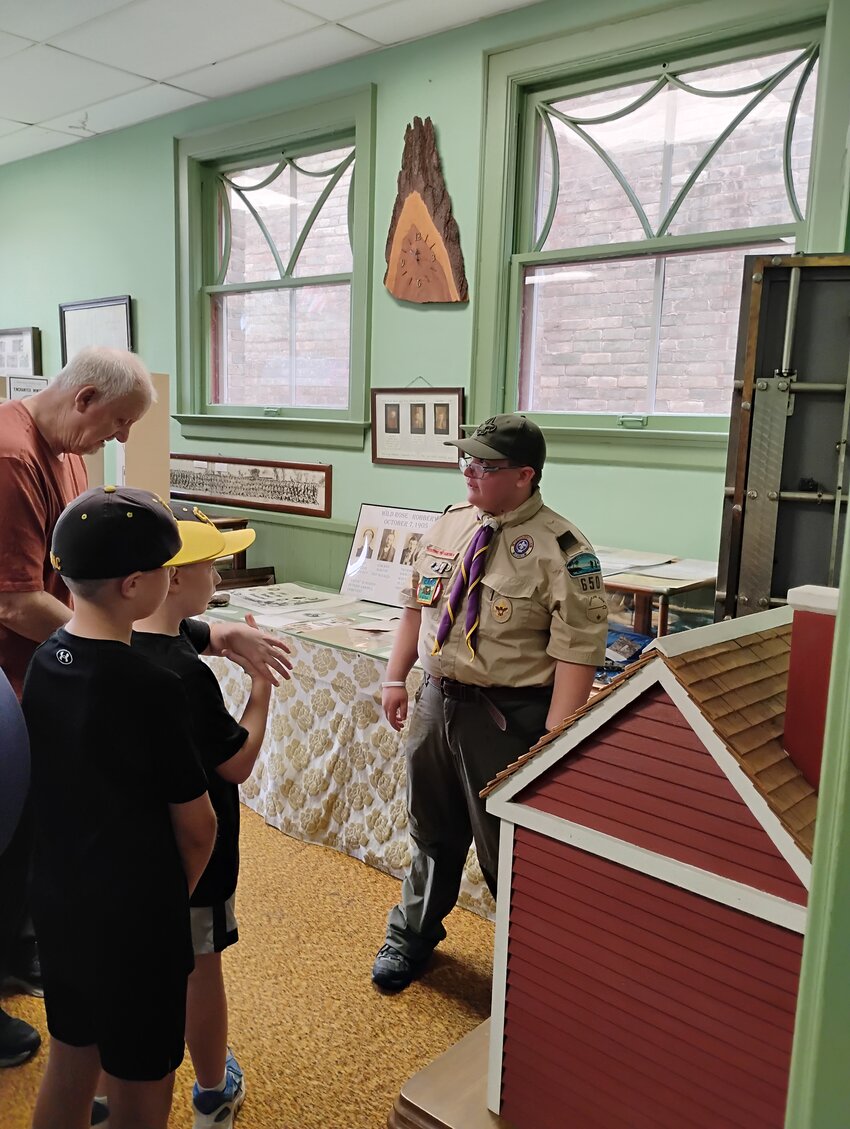
Mike handed me off to young Samuel Jensen, resplendent in his Boy Scout uniform. Samuel was my guide for the drug store/post office/bank building. Samuel is a new volunteer and specializes in pointing out amusing or gory things from the drug store, anything military, and the great bank and post office robbery from 1905. (Military uniforms and weapons were detailed ad nauseum while other areas got “a bunch of dolls here” or “over here some old clothing”.)
Helen Cox (Treasurer) led me through the next building, a former harness and shoe repair shop. It was formerly the gift shop for the Historical Society, but was taken over for more displays – a good idea in my opinion because there is much to be displayed. This building has a wall of musical instruments because James Ward Jeffers played in the Wild Rose Community Band. Ward Jeffers taught the drums to Meredith Wilson. Meredith Wilson composed The Music Man, inspired by the life of Ward Jeffers.
If I were homeschooling or had children, I would visit here when I covered Wisconsin settler history. Currently, Wild Rose and Plainfield school districts tour the museum. Wautoma, you should get on board.
Dedicated volunteers are the lifeblood of the museum and a worthy effort for retirees. For high schoolers looking for community service for their college applications, this is perfect for someone dependable and willing to learn to tell a story. Currently, they could use someone skilled in repairing spinning wheels, and then people who can demonstrate how to use a spinning wheel, as the museum owns four.
The museum is open from Memorial Day weekend to Labor Day weekend, Wednesday and Saturday, 10 a.m. to 1 p.m. Admission is free or a donation. See
www.villageofwildrose.com/history/ or look them up on
Facebook.
Come and see! You will be pleasantly surprised.




Comments
No comments on this item Please log in to comment by clicking here